
Our new report looks at the history of temporary accommodation, from 1834 - 2011, and makes recommendations for systemic change
We are excited to present Lifelines, a report that traces how temporary accommodation (TA) has developed since the Poor Law Amendment Act was passed in 1834, establishing the workhouse regime. Although the workhouses were famously punitive and meagre, explicitly designed to deter people from seeking assistance, the Poor Law Amendment Act of 1834 established TA as a safety net in law; a right that persists to this day.
This report traces how this basic right has been interpreted, experienced, delivered and contested in England since, ending in 2011 with Justlife’s establishment. It charts what has changed, what has been stubbornly persistent, and points to specific actions needed if we are to change course.
Striking similarities
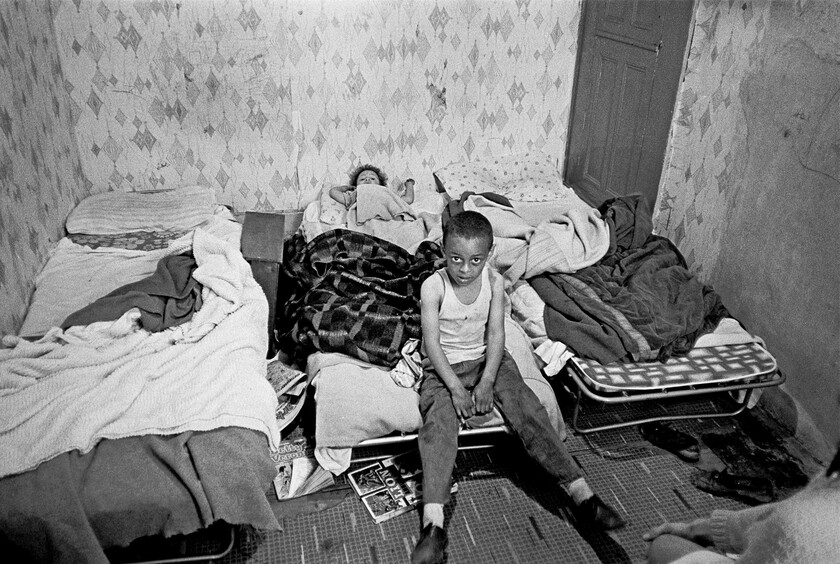
While much has changed since the Poor Law of Victorian times, some things have changed very little. Most of us have seen an unprecedented improvement in standards of living compared to the 19th century. Meanwhile, standards have been consistently poor across much of the accommodation used for TA. It is disheartening to see 60-year-old photographs of overcrowded rooms that could have been taken today.
The continuities over time are striking. The ticket that gave access to the Bermondsey Workhouse in 1839 is almost identical to the ticket that gave access to the Camberwell Reception Centre nearly 140 years later. Historical revelations of families sharing beds in cramped conditions, the removal of children from their families due to homelessness, respiratory illnesses, relocation to poorer areas; these are things we battle with today.
Running throughout is a persistent ideological filter that divides people according to how deserving they are, creating radically different outcomes for different groups of people. It may not be intentional, but it is discriminatory. To illustrate how this has happened, the report highlights the experiences of three groups in particular - the single adult, the “problem families” and racialised communities - all of whom have been deemed as less deserving at different times.
Patchwork approach creates fragmentation
Today, there is a growing recognition that everyone deserves a safe and secure home, regardless of circumstances or background. It is a basic human right under the Human Rights Act of 1998. While the UK is a signatory to this international convention, the government only recognises the right to provide temporary help in domestic law, but only under certain circumstances.
The sky-rocketing financial and human costs that are becoming so apparent today, are a clear indicator that the system, that is meant to secure the right to TA, is not fit for purpose. Over time, the report shows how this has happened by default, through a mix of devolution to local authorities, private sector outsourcing, and wide-ranging discretionary powers that inevitably has led to gate-keeping. Nationally, TA sits with Housing, Homelessness, Welfare and the Home Office. Nobody has the full picture.
This lack of statutory coordination has created unmanageable fragmentation, allowing discriminatory harms to go undetected, and obscuring good as well as bad practice. In such a situation, how can we possibly learn what needs to change.
Looking back can help us see the way forward
This report is a good place to start. It shows how tinkering around the edges can create positive outcomes for some, perhaps, only to leave the structures and ideologies that underpin a failing system intact. The inadequacy and short-termism of this approach is evident in the rising numbers of people in TA, and the increasingly unsustainable cost to local authority budgets as well as to individuals and families, who have no choice but to turn to TA for help.
This patchwork approach has not worked. Concluding that substantial reform is needed to break the cycle of these deep-rooted historic patterns, the report finally offers three lessons for systemic reform, leaving us with a clear steer as to where we can make the meaningful change that is so desperately needed today.
Illustrated with historical photographs, it is an arresting read that should be top of the reading list for anyone wishing to understand why temporary accommodation so often fails to be the safety net promised in law.
Read the full report here


